Saudi Arabian Gaming Market: An Overview
• Saudi Arabia is rapidly emerging as one of the world’s most prominent gaming powerhouses.
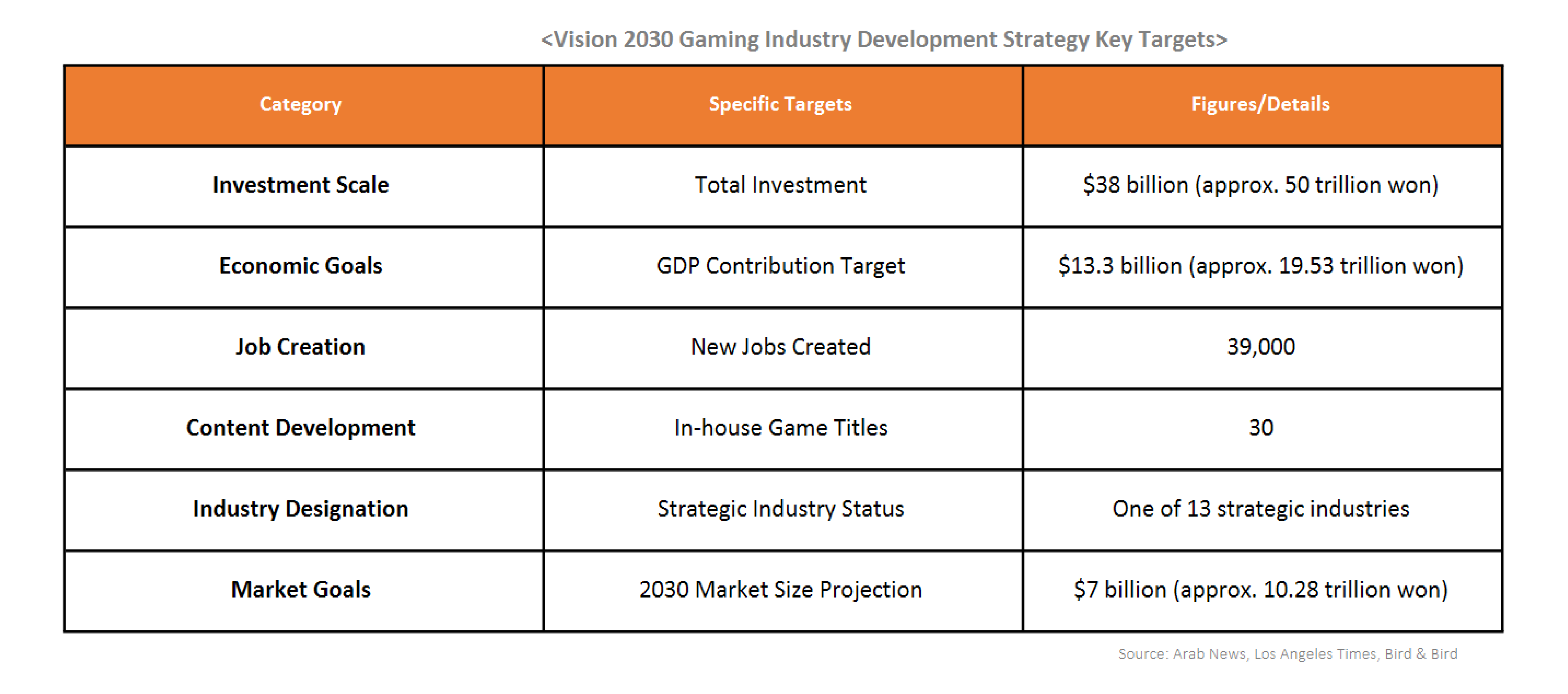
• This growth is driven by Crown Prince Mohammed bin Salman’s “Vision 2030” initiative, which aims to diversify the economy away from oil dependency toward advanced digital content industries. The project commits approximately $38 billion (approx. 50 trillion won) to gaming and esports, with the goal of establishing the nation as a global gaming hub.
• This goes beyond simple industry development, since the Crown Prince himself is an avid gamer (particularly a League of Legends enthusiast), reflecting a strong commitment from the nation’s highest leadership.
• Saudi Arabia’s gaming industry development strategy includes specific numerical targets: creating 39,000 new jobs by 2030 and increasing the gaming industry’s GDP contribution to $13.3 billion (approx. 19.53 trillion won).
• Additionally, the country is focused on developing 30 game titles domestically to build local game content creation capabilities. The government has streamlined game licensing and content rating processes through the Ministry of Communications and Information Technology and the General Commission for Audiovisual Media, while establishing game development programs at universities and specialized institutions to cultivate local talent.
• Furthermore, Saudi Arabia hosted its first Esports World Cup (EWC) in Riyadh in 2024, offering a record-breaking total prize pool of $60 million (approx. 830 billion won). The 2025 tournament expanded to a $70 million prize pool (approx. 1.028 trillion won) across 25 titles, establishing itself as the world’s largest esports event.
● Explosive Growth of the Saudi Arabian Game Market and Localization Requirements
1. Emergence as the Middle East's Largest Market, Projected to Reach $7 Billion (Approx. 10.28 trillion won) by 2030
• Saudi Arabia’s game market is recognized as the largest and fastest-growing market in the Middle East.
• In 2024, the Saudi game market recorded revenues of approximately $1.19 billion (approx. 1.5 trillion won), accounting for 20% of total gaming revenue across the Middle Eastern and North African (MENA) region, ranking first.
• The number of gamers in Saudi Arabia is estimated to be approximately 25.81 million, with a gamer-to-population ratio exceeding 70%, representing an overwhelmingly high figure equivalent to about two-thirds of the entire population.
• This is due to a combination of factors including a young demographic structure with an average age under 35, high internet penetration rates, and preference for indoor activities driven by a hot climate. This has established gaming as a national pastime.
• According to Saudi government reports, 67-89% of citizens enjoy gaming, and 48% of Saudi women identify themselves as gamers, demonstrating a characteristically broad participation base.
• Driven by increased spending from this broad user base and infrastructure improvements, the value of the Saudi gaming market is projected to exceed $7 billion (approx. 10.28 trillion won) by 2030.
• Looking at the Middle East as a whole, the gaming market is confirmed to be expanding from $7.1 billion (approx. 10.43 trillion won) in 2022 to $10 billion (approx. 13 trillion won) by 2025, with Saudi Arabia serving as the driving force behind this growth.
2. Reflecting Arab Culture and Content Review Based on Islamic Law
• The Saudi Arabian gaming market has unique characteristics that emphasize local culture and religious values.
• Gamers in the Middle East region have a very high demand for content that properly reflects their language and culture.
• According to a survey by the Saudi Esports Federation, 75% of all gamers consider proper portrayal of Arab culture in games important and 41% responded that they only play games localized in Arabic.
• This means that game localization must go beyond simple language translation to include implementation of stories and characters that reflect cultural context and sentiment.
• For example, “AZOOMA Escape,” a Saudi indie game exhibited at Gamescom 2024 in Germany, gained attention as a stealth action game that comically portrayed Saudi Arabia’s multigenerational extended family culture, with the developer stating they drew inspiration from Saudi family culture to create local resonance.
• Another cultural consideration is content censorship and adjustment to comply with religious norms. Saudi Arabia has conservative cultural norms based on Islamic law as the foundation of its government. So, if game content contains elements that violate these norms, release may be restricted or modifications may be required.
• Depictions of the Prophet Muhammad, expressions related to homosexuality or drugs, and explicit sexual content are classified as unacceptable elements in Islamic culture, making local release impossible if included in games.
• For this reason, global game publishers need to exercise special caution when considering Middle Eastern releases. These include reviewing culturally sensitive elements from the initial development stage or going through consultation and approval procedures with local authorities before release.
● Korean Gaming Industry's Middle East Market Strategies for Entering and Implications
1. Utilizing Saudi Arabia as a Bridgehead for Entering the 400 Million Population Market of the Middle East
• Saudi Arabia holds a tremendous strategic value for the Korean gaming industry as a bridgehead for entering the Middle Eastern market.
• The Saudi gaming market is not only the largest in the Middle East, but also creates a very favorable environment for foreign companies through government-led opening policies. In fact, in 2023, Prince Faisal bin Bandar, Chairman of the Saudi Esports Federation, visited Korea and met with executives from major Korean game companies including Nexon, NCSOFT, Netmarble, Krafton, and Smilegate to discuss cooperation plans, demonstrating Saudi Arabia’s high interest in Korean games and active provision of business opportunities.
• By establishing Saudi Arabia as a base, it becomes easier to strategically target the 400 million population market of the Middle Eastern and North African (MENA) regions in stages. Companies that preemptively enter the Saudi market are highly likely to gain dominance over the entire Middle East.
• As an example, Saudi Arabia is not simply a single market, but a strategic base for targeting the entire Middle East and a key market that can become a new growth engine for the Korean gaming industry.
2. Thorough Cultural Localization and Establishment of Local Partnerships Essential
• The most important factor in Korean games entering Saudi Arabia is compliance with local culture and regulations.
• Halalization of game content, meaning content creation that does not violate Islamic culture, and response to censorship are essential. It is necessary to thoroughly review local laws and prohibited elements in advance, and if needed, create separate versions or modify content, along with thorough language localization and customer support preparation.
• Game text localization and establishment of social media operations and customer service centers that can communicate in real-time with local users is also important.
• Securing local partners and distribution networks is also an essential strategy. Partnering with publishers or platform operators familiar with the Middle East region can help overcome cultural differences and efficiently utilize marketing channels.
• Participating in government-led incubators or joint development projects is particularly advantageous, as it provides financial support while helping establish government connections that facilitate business expansion.
• Given Saudi Arabia’s stake investments in Korean gaming companies, there is room to explore new business models based on these relationships (such as Korean-Saudi joint venture games developed with Saudi capital, or games utilizing Saudi local IP). This would allow the Korean game industry to positively consider such proposals and establish a strategy to deeply root itself in the Saudi market.